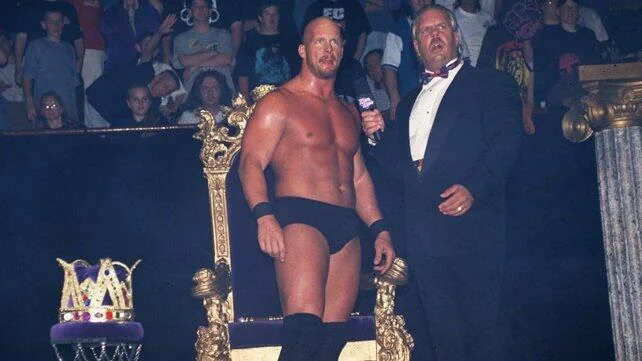
King of the Ring began in 1985 and has produced 25 completed men's tournaments through 2026, most recently won by Oba Femi. This guide covers every winner, the changing format and prize, and the different ways wrestlers used the crown. Historical match results and storyline developments appear below.
King of the Ring began before its pay-per-view identity
King of the Ring is a WWE tournament whose history begins in 1985, before the pay-per-view event that many fans remember. Don Muraco won the inaugural edition. The name later became associated with an event card, a televised bracket and the royal characters adopted by some winners, but those meanings are related rather than interchangeable.
The simplest distinction is between a tournament and the event carrying its name. A tournament produces a winner through its bracket. A pay-per-view card can also contain championship matches and other rivalries that are outside that bracket. Winning the main event of a King of the Ring card does not automatically make a wrestler that year's tournament winner.
The crown is another distinction. Some winners turned royalty into their ongoing identity; others used the achievement to support a character that had little interest in royal robes. A wrestler being called “King” is therefore not sufficient proof that he won this particular tournament.
The 1993 event changed how viewers encountered the tournament
The first King of the Ring pay-per-view was in 1993. Bret Hart won its tournament, having also won an earlier edition in 1991. This is why an account can correctly describe him as the first pay-per-view winner without making him the first winner in the competition's entire history.
WWE centred a pay-per-view around the tournament from 1993 through 2002. Its retrospective on that event format explains why the competition became associated with a night of rising stars, championship matches and consequential character developments.
Later editions did not all reproduce that arrangement, and the tournament has not run every calendar year. When reading an archive list, an absent year generally means there is no edition to list. Filling the gap with whoever happened to have a royal nickname would create a result that never occurred.
Every men's King of the Ring winner from 1985 through 2026
As of October 19, 2026, Oba Femi is the latest men's King of the Ring tournament winner. He defeated Jey Uso in the final at Night of Champions on June 27, 2026. WWE's completed official bracket records that result.
The table lists completed men's editions, including the years before the tournament became a pay-per-view attraction. Missing calendar years are intentional. Women's Queen's Crown and Queen of the Ring results belong to their own competition and are not inserted into this men's winners list.
| Year | Tournament winner |
|---|---|
| 1985 | Don Muraco |
| 1986 | Harley Race |
| 1987 | Randy Savage |
| 1988 | Ted DiBiase |
| 1989 | Tito Santana |
| 1991 | Bret Hart |
| 1993 | Bret Hart |
| 1994 | Owen Hart |
| 1995 | Mabel |
| 1996 | Steve Austin |
| 1997 | Triple H |
| 1998 | Ken Shamrock |
| 1999 | Billy Gunn |
| 2000 | Kurt Angle |
| 2001 | Edge |
| 2002 | Brock Lesnar |
| 2006 | Booker T |
| 2008 | William Regal |
| 2010 | Sheamus |
| 2015 | Wade Barrett, competing as Bad News Barrett |
| 2019 | Baron Corbin |
| 2021 | Xavier Woods |
| 2024 | Gunther |
| 2025 | Cody Rhodes |
| 2026 | Oba Femi |
Bret Hart appears twice because he won two editions. That makes 25 completed tournaments and 24 different winners across this list. The long gaps also show why describing King of the Ring as an uninterrupted annual event would be misleading.
Keep a competitor's name at the time beside any later royal identity. Booker T's victory led into King Booker, and Barrett's victory led into King Barrett. Those names do not create additional tournament wins. Equally, a later storyline involving possession of a crown does not automatically add another champion to this historical bracket record.
The most recent stretch includes Gunther's 2024 win, Cody Rhodes' 2025 win and Femi's 2026 win. A list ending with Woods in 2021 or Gunther in 2024 describes an older snapshot. When using a historical compilation, check its last included year before treating it as a current all-time list.
The crown could change a wrestler's character or career
The competition's lasting value is easier to see through contrasting winners than through a single formula. A tournament can demonstrate endurance, give an ambitious character another grievance, introduce a memorable phrase or supply an elaborate new identity. Those developments are creative possibilities rather than guaranteed consequences of winning.
Bret Hart made the tournament performance itself matter
In 1993, Bret Hart defeated Razor Ramon, Mr. Perfect and Bam Bam Bigelow on the pay-per-view to win the tournament. Following all three matches reveals a performance built across a night: each opponent creates a different problem, and the winner's route matters as well as the final result.
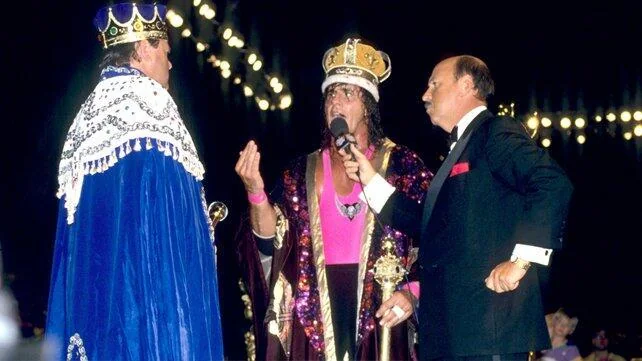
This is a useful first watch because it gives the bracket a narrative of its own. An earlier round is not merely paperwork required to reach the main attraction. Opponents, time spent wrestling and what a match establishes about the winner can accumulate across the event. Bret's victory also should not be confused with winning a world championship on the same night.
Owen Hart and Steve Austin took different identities from victory
Owen Hart won in 1994 and embraced the King of Harts identity. His achievement sat within a different family and character context from Bret's tournament performance. Similar surnames and related stories do not make their victories the same edition or the same dramatic development.
Austin's 1996 win over Jake Roberts produced another kind of aftermath. The “Austin 3:16” interview followed the final and became a defining statement of his emerging character. He did not need to build that identity around politely wearing a crown and ruling a fictional court.
Do not compress the victory into an instant world-championship coronation. The tournament supplied a platform for a significant character moment; the later championship career had its own matches and dates. Watching the final and interview together preserves that sequence without turning the entire following era into something that happened in a few minutes.
King Booker made royalty a continuing television story
Booker T's 2006 victory took the royal possibility much further. King Booker, Queen Sharmell and the surrounding court made the crown an ongoing source of ceremony, arrogance and conflict. The achievement became a weekly character presentation rather than a line in a career summary.
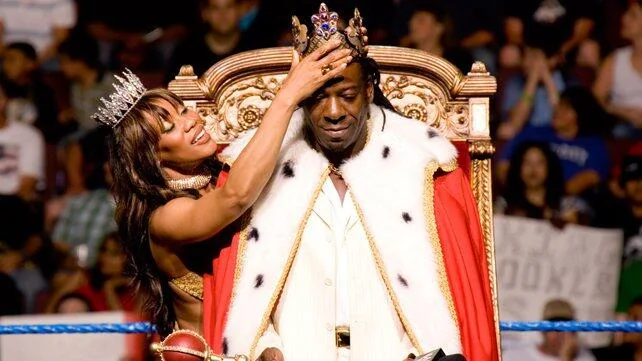
The humour and antagonism depended on how the character treated other wrestlers. Royal language and ceremony gave opponents something to challenge beyond the fact of a tournament result. It is a very different use of victory from Austin's rebellious interview, even though both men occupy the same winners table.
These examples explain why counting later championships cannot fully describe the tournament's impact. Look at what the next episodes actually did with the achievement. Some winners became kings in character, while others remained recognisably themselves with an additional credential.
The bracket and the prize need the context of their year
There is a consistent idea behind King of the Ring: competitors progress through a tournament until one winner remains. The schedule, opening-round match type and reward have varied. Read the bracket for the edition you are watching before applying rules remembered from a different year.
A tournament can unfold across several programmes
A pay-per-view centred on the competition does not necessarily contain every qualifying match. Television episodes can establish the field or host earlier rounds, leaving later matches for the named event. Other editions have used a dedicated television or streaming presentation for the concluding rounds.
The 2021 bracket, for example, progressed through Raw and SmackDown before its final. WWE's April 28, 2015 special presented semifinals and a final. These are different viewing arrangements from assuming that every entrant must wrestle all of his tournament matches during one pay-per-view broadcast.
The 2026 men's bracket also shows why “every round is a singles match” is an unsafe historical shortcut. It began with four multi-person first-round matches, followed by two singles semifinals and the final. WWE's June 5 SmackDown report explicitly described the relevant opening contest as a Fatal 4-Way.
When an archive search produces several clips with the tournament name, note the round and date. A semifinal win advances a wrestler; it does not award the entire competition. Read the announced result when an unusual finish occurs rather than assuming how a bracket must handle it from ordinary match rules.
A championship opportunity has not been a universal prize
The crown has supported championship stories in particular years. Brock Lesnar's 2002 win led toward his SummerSlam WWE Championship opportunity. In 2024, Gunther's victory carried a SummerSlam title opportunity, and the 2026 bracket announcement again specified a championship match at that year's SummerSlam for the tournament winners.
Those examples should remain attached to their years. They do not establish a permanent rule governing every edition since 1985. Earlier achievements and the character directions discussed above need their own context. A later prize announcement cannot retroactively explain what every older winner received.
A title opportunity is also different from a championship. Winning the bracket does not itself transfer a world title, and the crown is not automatically an anytime cash-in contract like Money in the Bank. Follow the announcement that names the championship opportunity and the subsequent match record.
For modern events, separate the men's and women's brackets as well. They can share a card and a comparable reward without becoming one competition. Checking which wrestler advanced in which bracket prevents a combined event headline from obscuring two distinct tournament results.
Watch the tournament and the event card as separate stories
A famous King of the Ring match may have no part in deciding the tournament winner. The Undertaker and Mankind's Hell in a Cell encounter belongs to the 1998 event, but Ken Shamrock won that year's King of the Ring tournament. Remembering the card through its most discussed spectacle should not erase the bracket's separate result.
This distinction also helps when a search returns a world-championship match under the event name. Look for the round label: quarterfinal, semifinal or final. A title defence may be a major part of the broadcast without advancing anyone through the tournament at all.
A short viewing route connects the different versions
Begin with Bret Hart's 1993 tournament matches as a connected sequence. Watch how the different opponents change the problem he must solve. The appeal lies partly in the accumulated performance, so starting and ending with only the last few minutes of the final leaves out much of what makes this edition useful.
Next, watch Austin's 1996 final and the interview that followed. Separate the recorded win from the character statement. This stop shows how an aftermath can become more widely remembered than the bracket itself, while still depending on the opportunity created by that win.
Move to Booker T's 2006 victory and the King Booker presentation that followed. Give the story more than a single coronation clip: the value of the royal identity appears in how it interacts with other characters over subsequent television. Compare that deliberate embrace of royalty with Austin's very different response to winning.
Then try the 2015 concluding rounds. Barrett's semifinal and final on the dedicated special provide another way of packaging the competition. Finally, use the completed 2026 bracket to follow Femi's progression into the Night of Champions final. That modern endpoint connects the historical list to the latest completed edition without pretending the format stayed frozen.
For each stop, keep a small viewing note with the year, tournament round, opponents, result and aftermath. If a clip lacks the ending or starts after a crucial interview, find the full match or surrounding show where your regional catalogue permits. WWE's finals playlist is a useful navigation aid, but its televised scope does not cover every part of the earliest history.
Historical pages may retain subscription promotions from the time they were published. Check present availability for the exact event in your country rather than assuming an old “watch now” message guarantees access. Use our WWE viewing guide for current access information.
For the wider context around Austin and Booker, continue with the Attitude Era guide and Ruthless Aggression guide. The crown's history becomes more interesting when a winner's individual story remains visible inside the tournament record.
Read the winners list alongside each edition's bracket and the next chapter of its winner's career. That preserves the competition's record while explaining why its crown has meant different things to different generations of WWE fans.
Join the discussion
Comments