The WWE Ruthless Aggression era is commonly framed as 2002 to 2008, when a divided television roster and a rising generation reshaped the company. This guide explains the dates, brand split, defining wrestlers and a practical match watchlist. Historical match results appear below.
Ruthless Aggression began with a changing WWE in 2002
The Ruthless Aggression era describes WWE's rebuilding period after the Attitude Era: established attractions remained, but a different generation began taking control of the main event. This guide uses roughly 2002 to 2008 as its working frame. That helps organise the programmes without pretending an entertainment company changed every aspect of its identity on a single night.
Several changes crowded into 2002. WWE was developing separate Raw and SmackDown rosters, introducing new wrestlers to its television audience and adjusting to a business without WCW as its weekly rival. The company also announced its change from WWF to WWE on May 6. That corporate announcement belongs in the timeline, but the initials alone do not define a wrestling style.
The phrase and John Cena's debut were different moments
On the June 24, 2002 episode of Raw, Mr. McMahon demanded “ruthless aggression” from the roster. His speech supplied the phrase subsequently used to describe the period. Watch it as a character addressing other characters within WWE's presentation, alongside its role as a statement of creative direction.
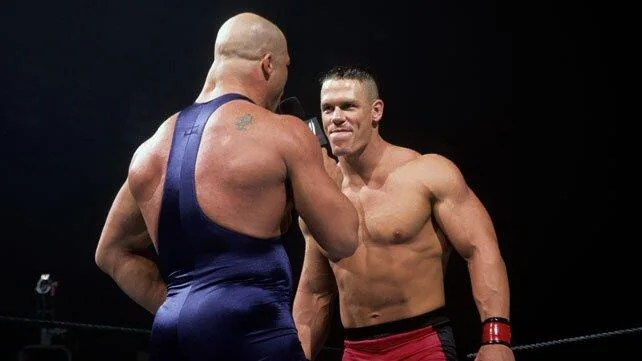
John Cena's televised debut followed three days later, on the June 27 SmackDown. He answered Kurt Angle's challenge and identified ruthless aggression as the quality he possessed. Cena lost the match. His importance to this story comes from the opportunity and the impression he made, rather than an invented debut victory or an immediate coronation as the company's leading star.
WWE's dated Raw clip and Cena debut footage make that distinction easy to retain. They are connected moments on different programmes.
Treat the era's dates as a useful historical frame
An era label is a retrospective organising tool, not an official match stipulation with a bell at either end. A viewer following a particular wrestler may place the transition differently from somebody tracking television presentation or roster structure. Some Attitude-era characters continued into this period, while future Ruthless Aggression stars had careers before their WWE introductions.
For a first viewing, begin with the changes of 2002 and work forward. Keep a match's precise broadcast or event date alongside the broader era label; each answers a different historical question. That approach makes room for overlap and prevents the familiar phrase from swallowing every important development of the decade.
The brand split changed how Raw and SmackDown worked
The brand extension is essential to understanding this era. Raw and SmackDown became homes for different groups of wrestlers, creating separate weekly routes through WWE's stories. Both remained WWE programmes. Their on-screen rivalry did not make them independent companies or recreate the business relationship between WWE and WCW.
For viewers, the useful change was continuity. A rivalry developing on one show could progress without requiring the same wrestlers to dominate the other programme that week. Following both shows offered different combinations of personalities and opponents; following just one could still provide a coherent championship picture. The division also created more room for wrestlers below the established headliners.
The first draft divided a shared roster
The inaugural draft took place on Raw on March 25, 2002. Mr. McMahon chose The Rock for SmackDown, while Ric Flair selected The Undertaker for Raw. Those first selections illustrate the scale of the change: major names were being assigned to different television destinations rather than simply advertised across the whole schedule.
The arrangement had exceptions and changed over time. Triple H initially remained eligible to appear on both shows as WWE Champion. That matters when watching early episodes: a shared champion crossing the divide is not evidence that the draft never happened. WWE was working through the implications of the new structure within the stories themselves.
Think of the draft as a new starting position, rather than a permanent list that explains every subsequent year. Later moves could change an opponent's availability or carry a championship to a different show. For an archive watch, identify the episode date first and establish which roster arrangement applied then. A later draft cannot explain an earlier show's available opponents.
Separate championship paths gave each show its stakes
Later in 2002, Brock Lesnar became exclusive to SmackDown while holding the WWE Championship. Raw then needed a top championship of its own. On September 2, Eric Bischoff awarded Triple H the World Heavyweight Championship. This was an on-screen presentation of the new title, rather than Triple H winning a tournament final that night.
WWE's history of that championship's introduction records the sequence. In an old results listing, “WWE Championship” and “World Heavyweight Championship” therefore identify different prizes. Read the full title name rather than treating every world-title reference as the same belt.
That distinction also prevents confusion with championships introduced in later decades. The 2002 World Heavyweight Championship belongs to its own historical record. Once those parallel paths are clear, the era's main events become much easier to follow: one company's television schedule could support more than one headline championship rivalry.
New main-event stars developed alongside established wrestlers
Four names provide a useful starting point: Brock Lesnar, John Cena, Randy Orton and Batista. Their shared association with Ohio Valley Wrestling helps explain why WWE's developmental system is prominent in accounts of the period. It does not mean they arrived with interchangeable characters or reached the main event on the same timetable.
Brock Lesnar made immediate dominance his identity
Lesnar appeared on Raw on March 18, 2002. With Paul Heyman beside him, his presentation emphasised explosive strength and the prospect of an unusually rapid rise. At SummerSlam on August 25, he defeated The Rock for the WWE Championship. He was 25, becoming the youngest WWE Champion.
That championship name matters. Orton's later distinction concerned the World Heavyweight Championship; the two achievements should not be flattened into contradictory claims about the same record. Lesnar's initial WWE run also should not be confused with his return in 2012. His later accomplishments are a separate chapter from the rookie ascent that helped establish this era.
Cena, Orton and Batista followed different routes upward
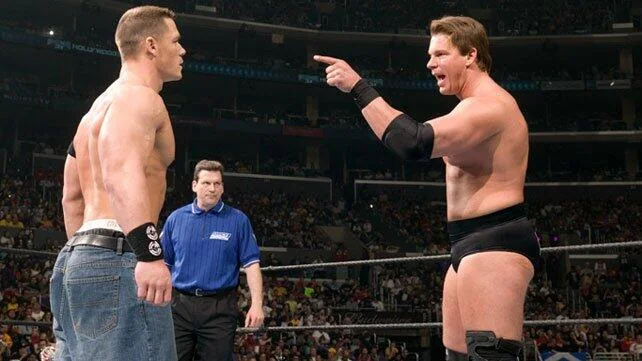
Cena's earnest debut appearance developed into the rapping Doctor of Thuganomics character. Watching that change gives context to his connection with the crowd: the familiar franchise figure did not emerge fully formed on his first television night. At WrestleMania 21 in 2005, Cena defeated JBL for the WWE Championship, a major step beyond the opening challenge against Angle.
Orton and Batista developed through Evolution alongside Triple H and Ric Flair. The faction connected established status with emerging ambition: younger wrestlers could benefit from that association and eventually challenge the order it represented. Orton became the youngest World Heavyweight Champion, while Batista's break with Triple H supplied another route to the top.
At WrestleMania 21, Batista defeated Triple H for the World Heavyweight Championship. Put that result beside Cena's victory over JBL and the significance becomes clear: two new champions led separate championship stories. To understand those breakthroughs, watch the opponents and the build to each match as well as the celebrations. The two title changes complete different stories on the same card.
Veterans and specialists kept the period from having one style
The new generation did not perform in an empty ring. Triple H, The Undertaker, Shawn Michaels and Kurt Angle gave younger opponents established personalities to measure themselves against. WrestleMania 21 also paired Angle with Michaels and Eddie Guerrero with Rey Mysterio, showing why a history built only around the four developmental graduates would miss much of the appeal.
Women's wrestling belongs in the account too. Trish Stratus and Lita are central figures when following this period's women's stories, although the opportunities and presentation differed from later WWE women's divisions. Avoid projecting today's roster structure backwards onto those programmes.
Instead of trying to name one wrestler who represents every episode, follow several contrasting threads. A powerhouse's abrupt breakthrough, a faction member's struggle for independence and a veteran's technically focused rivalry offer different ways into the same television years. That variety is a better guide than treating “aggression” as a promise that every match must look alike.
The matches show more than a single aggressive style
The era's name can give a misleading first impression. Its appeal includes new stipulations, but also straightforward championship matches, faction conflicts and encounters built around contrasting personalities. A useful watchlist should reveal those differences instead of presenting a row of spectacular clips detached from their stories.
The following route is an editorial selection for understanding the period. It is not a claim that these are objectively the highest-rated matches, or that every important wrestler can be represented in a few stops. Historical results are included so that the significance of each selection is clear.
A short route through the championship and stipulation matches
| Match or event | Result and reason to watch |
|---|---|
| Survivor Series 2002: first Elimination Chamber | Shawn Michaels won the World Heavyweight Championship. Watch how the new structure changed a multi-wrestler title match's rhythm. |
| WrestleMania 21: first Money in the Bank Ladder Match | Edge won the championship-opportunity contract. The prize was a future opportunity rather than an immediate championship victory. |
| WrestleMania 21: Kurt Angle vs. Shawn Michaels | Angle defeated Michaels. This provides a contrasting encounter built around two established individual performers. |
| WrestleMania 22: Trish Stratus vs. Mickie James | James won the Women's Championship. Include the preceding character story when watching the match. |
| Unforgiven 2006: Edge vs. John Cena | Cena regained the WWE Championship in a TLC Match. An established stipulation became the setting for a headline singles rivalry. |
The two first-time match concepts had different purposes. The Chamber settled a championship contest inside its structure, whereas Money in the Bank created a continuing threat beyond the ladder match itself. Watching what happened after Edge claimed the briefcase is part of understanding why the concept mattered. The ladder-match celebration therefore introduces a second question for viewers: when will the winner exercise the contract? Keep that opportunity separate from the later title match itself.
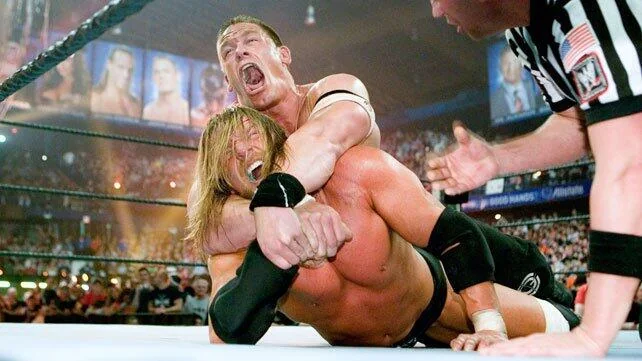
For another championship contrast, add Cena's WrestleMania 22 defence against Triple H. It places an emerging leading champion opposite an established main-event name without needing a ladder or chamber to explain the stakes. Then move to the Edge rivalry and notice how the audience, opponent and stipulation change the atmosphere.
Use WWE's complete event results to choose an exact match, then locate the preceding television episodes if the opening exchanges feel underexplained. Entire cards also show contrasts that isolated highlight compilations lose: a championship bout and a different presentation could occupy the same event. That makes the original running order useful historical context.
Watch the era with its transition and documentary context intact
Two different things appear in searches for Ruthless Aggression: the historical period and WWE's later documentary series about it. Both are useful, but they answer different needs. Original episodes show how stories unfolded for the audience at the time. Retrospective interviews explain how selected participants remember and interpret those years.
The 2008 television shift is an endpoint convention
WWE itself has used 2002 to 2008 in an era poll. The broader move toward PG-rated programming in 2008 provides a practical endpoint for this guide. A corporate statement dated July 28, 2008 announced that its network distributors rated WWE's weekly programmes PG. That is a dated announcement about television presentation, rather than proof that every wrestler's story ended on that date.
The transition did not erase the stars, match concepts or separate television identities developed earlier. A viewer moving into later programmes will find continuing careers and familiar ideas. This is why a useful historical boundary needs an explanation: it marks a change of emphasis while allowing ongoing stories to cross it.
Archive footage also retains the standards and creative choices of its time. Check content advisories before choosing episodes for younger viewers. The era label alone is not a rating, and today's programme descriptions should not be substituted for the contents of an older show.
Use the documentary as a companion to the original shows
The documentary's first season launched in 2020, with a second season announced for November 2021. Its subjects include the brand split, rising stars, women's wrestling, developmental routes and match innovations. Those themes can help a newcomer choose a starting point without committing immediately to years of weekly television.
However, a retrospective is an edited account built around selected footage and interviews. After an episode introduces an interesting rivalry, locate the original event and the television build. Follow the original build and finish alongside the later explanation. The interview and the broadcast each supply a different kind of context. That produces a richer understanding than using a short interview clip as a complete history.
Old launch articles also contain old subscription promotions. Check the current catalogue offered in your country for the exact series, season or event rather than assuming a 2020 or 2021 platform announcement guarantees availability today. Keep the event year in your search, especially when a name such as Survivor Series identifies many different cards.
For the background to 2002, continue with our Attitude Era guide. When you return to current programmes, the WWE schedule provides the next viewing dates. The historical label becomes most useful when it helps connect those earlier changes with the wrestling you watch now.
Begin with the 2002 changes, follow both championship paths and choose several contrasting matches. The era becomes easier to understand when its roster structure, individual careers and later documentary accounts are kept in their proper sequence.
Join the discussion
Comments