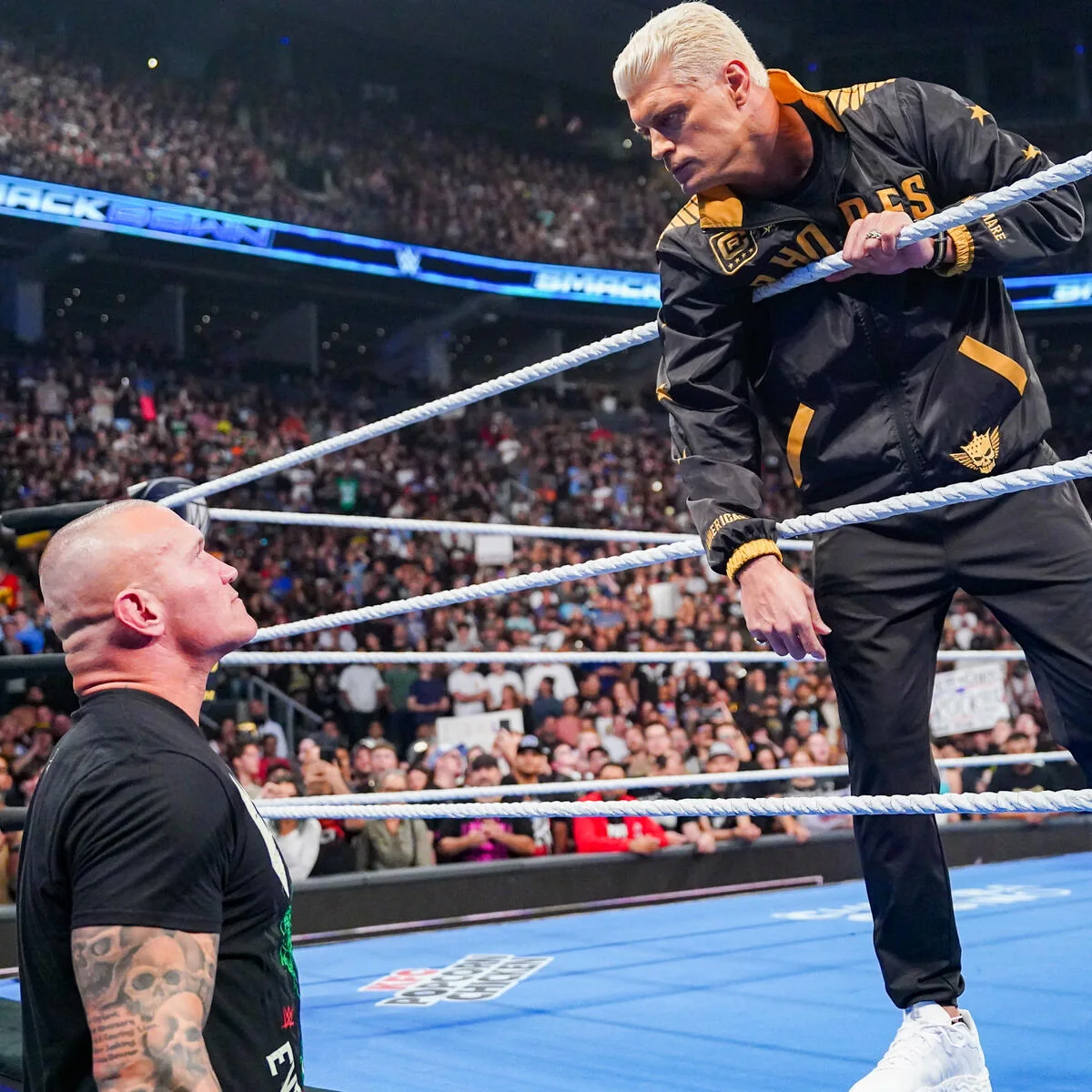
Cody Rhodes and Randy Orton's Crown Jewel 2026 match is decided by the referee's standing ten-count, not a pinfall or submission. WWE advertised the Last Man Standing stipulation after their October 23 confrontation. Here is how the rules work, why a count outside the ring means something different and what the format adds to their current rivalry. This preview is current through October 29; the November 7 match has not happened.
What WWE announced for Cody Rhodes and Randy Orton
Cody Rhodes and Randy Orton are advertised for a Last Man Standing match at Crown Jewel on November 7, 2026. The October 23 SmackDown supplied the turning point: General Manager Nick Aldis booked the meeting, and Rhodes proposed the stipulation. WWE's official show account records that sequence. This is an upcoming match announcement, not a result.
The essential viewing change is straightforward. Instead of expecting the referee to count three over a covered opponent, watch whether either man can answer the standing ten-count after being knocked down. A successful signature move may create the opening for that count, but it does not end the match automatically. The stipulation changes what a wrestler must accomplish after landing the move.
That makes the announcement more meaningful than simply arranging another encounter. A rivalry can reach a point where surviving a pin attempt no longer answers what the wrestlers want to prove about each other. Here the announced objective requires one man to keep the other down through the referee's count. The competitive test and the story's emphasis both move toward endurance.
This is a grudge match, not an advertised world-title defense
The official match preview names the Last Man Standing stipulation without advertising a world championship at stake. Do not import the title conditions from their WrestleMania encounter into this November match. An earlier championship match between the same performers does not make every later meeting a title defense.
It is also separate from the men's and women's Crown Jewel Championship matches on the event. Those annual champion-versus-champion prizes have their own entrants and stakes. Rhodes and Orton's advertised objective is to win this grudge match under its stated rules. For the distinction between those annual awards and regular belts, our Crown Jewel Championship rules guide explains the wider format.
Read the complete match name when checking the card. The event title tells you where the bout sits on the calendar; the stipulation tells you how it is meant to end; an explicit championship description tells you whether a belt is being defended. Keeping those details together avoids assigning stakes that WWE has not announced.
How the referee's ten-count decides the match
The central rule is that a wrestler loses when unable to answer the referee's ten-count after being put down. WWE's official stipulation explanation describes this as a test of keeping an opponent from recovering. The relevant count is the one administered by the official, rather than a viewer independently timing ten seconds from the first moment of contact.
That distinction changes the rhythm of the match. A wrestler can land a major move, step back and watch whether it has done enough. The opponent's attempt to recover becomes the next piece of action. Each late recovery postpones the result and gives the attacker another problem to solve. There is no fixed number of knockdowns that wins the match before the decisive count.
Pinfalls and submissions do not win Last Man Standing
Pinfalls and submissions are not winning conditions in this stipulation. A wrestler does not need to cover the opponent after an RKO or Cross Rhodes. Nor does a submission hold supply an alternative tapout victory. A hold can still be used as offense, but the announced objective remains preventing the opponent from answering the standing count.
WWE explained the same principle for Becky Lynch and Charlotte Flair's 2018 Last Woman Standing match. The terminology changes with the competitors; the key contrast with a standard singles match is the same. Shoulders on the canvas and the ability to rise are different tests. A move that normally creates an immediate near-fall instead needs to produce a sustained inability to recover.
This is different from an ordinary ringside count-out
An ordinary count-out concerns failing to return to the ring during the official's count. Last Man Standing removes that ordinary count-out route while retaining its own standing ten-count. WWE's Cena–Ryback match explanation explicitly separates those conditions. The similar number can be confusing, but the referee is judging a different problem.
Action outside the ropes therefore does not automatically become a race back into the ring. The competitors can continue fighting at ringside, and a downed opponent can still face the standing count there. Sliding under the bottom rope is not, by itself, the recovery the stipulation requires. Watch what the official is counting and how the wrestler responds.
For Rhodes and Orton, this means the ring boundary is not the usual escape route from a dangerous exchange. Moving outside may change the surroundings and available offense, but it does not remove the need to recover. That is the tactical consequence to follow, without assuming a particular weapon, location or planned finishing sequence has already been revealed.
What no disqualifications changes about weapons and interference
Last Man Standing removes disqualification as the ordinary way to end the contest. WWE's rules description also permits weapons. A chair appearing in the action therefore does not automatically create the familiar referee signal that ends a standard singles match. It becomes part of the attempt to keep the opponent down for the required count.
That permission does not tell us which objects Rhodes or Orton will use. It also does not establish that anyone else will interfere. Those are possible developments within the advertised environment, rather than confirmed elements of the match. A useful preview can explain why the stipulation allows a different kind of fight without inventing its choreography.
Additional restrictions still matter when WWE announces them. At Extreme Rules in 2011, the official Orton–CM Punk result explains that The New Nexus were banned from ringside before their Last Man Standing match. The broad match format and a specific ringside instruction can coexist. That historical example is a reason to listen to the final announcements, not a claim that an equivalent ban has been imposed at Crown Jewel.
There is also a difference between a legal finish and a satisfying one. A viewer can understand why a weapon or another person's involvement did not cause a DQ and still dislike how the story used it. Rules explain what the referee is enforcing. Editorial criticism asks whether the outcome addressed the rivalry's main question. For this feud, a heavily assisted win would invite a different discussion from one wrestler directly keeping the other down.
Watch the sequence around the decisive count: what caused the knockdown, whether anyone intervened and how the surviving wrestler remained upright. Those details explain the finish more accurately than simply saying “anything goes.” They also prevent a dramatic move from being mistaken for a real-world medical diagnosis. Describe what WWE presented and the recorded outcome; the broadcast spectacle does not independently establish an injury or recovery timetable.
Historical finishes show why staying down is the real test
Last Man Standing has produced more than one kind of finish. Some matches end after a major move leaves one wrestler unable to recover; others turn on the surroundings or an improvised restraint. Historical examples help explain the rule because they show what the referee was judging. They are illustrations of the format, rather than evidence for a planned Crown Jewel sequence.
Cena and Batista showed that restraint can beat another finishing move
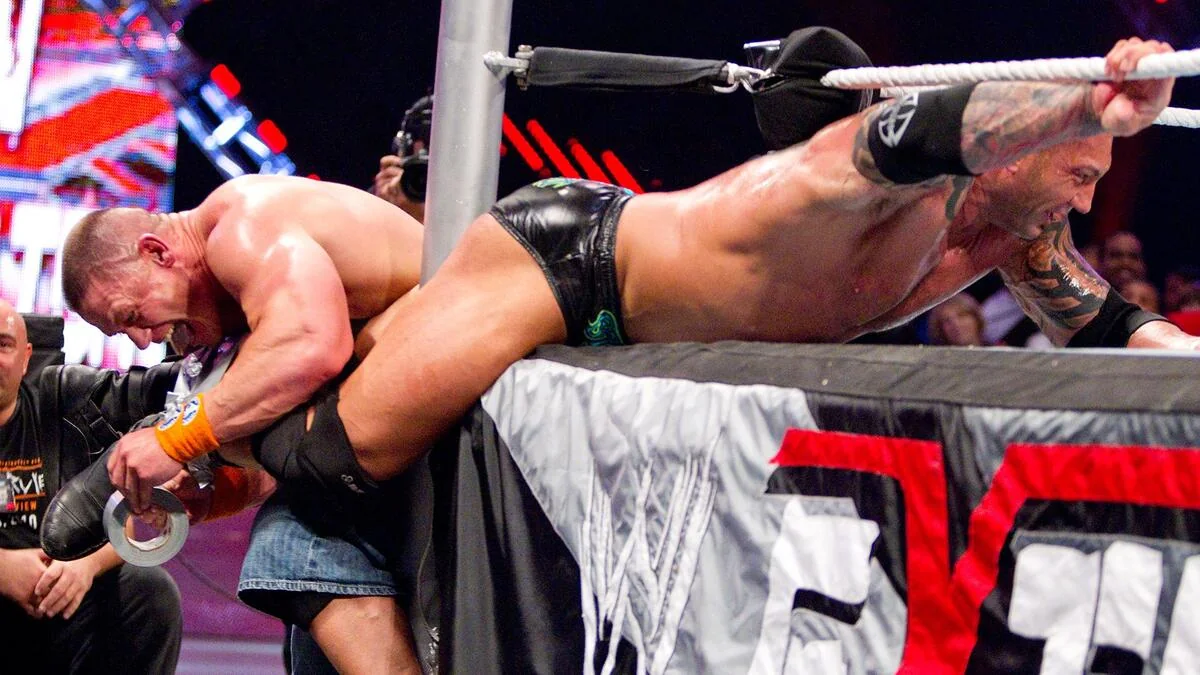
At Extreme Rules in April 2010, John Cena used duct tape to bind Batista's ankles around a ring post and prevent him from rising. WWE's account of the tactic makes the decisive distinction explicit: the opponent did not need to be knocked unconscious, only unable to stand before the official completed the count.
That is a particularly useful example for viewers expecting every stipulation match to end with the most powerful available finishing move. Cena solved a different problem. After the earlier offense had failed to keep Batista down, the restraint made recovery physically impossible within the count. The method addressed the stated winning condition directly.
It does not follow that Rhodes or Orton will use tape. The broader tactical lesson is that controlling an opponent's ability to rise can matter more than simply landing another strike. Where the wrestlers finish an exchange, what supports or obstructs them and whether the attacker also remains upright can all become important parts of the scene.
Both wrestlers staying down can prevent a winner
The stipulation's name is not a guarantee that a winner will always emerge. WWE describes Triple H and Shawn Michaels' Royal Rumble 2004 encounter as a draw. Its historical feature explains the final exchange left both unable to answer the ten-count. The essential result is that neither man won that match.
That history is useful when a preview promises a decisive-looking confrontation. The rules create a test the competitors must satisfy; they do not erase the possibility that both can fail it. If a future match reaches that situation, follow the official result and any subsequent instruction. Do not assume automatic overtime, an immediate restart or a winner selected from who landed the last move.
For Crown Jewel, the clearest finish would show one wrestler meeting the standing requirement while the other cannot. A double knockdown would need to be assessed by what the referee actually announces. This is why the final count matters more than the commentator's description of an earlier move as devastating: the result belongs to the completed sequence, not to an adjective before it.
Why the stipulation fits Cody and Orton's current rivalry
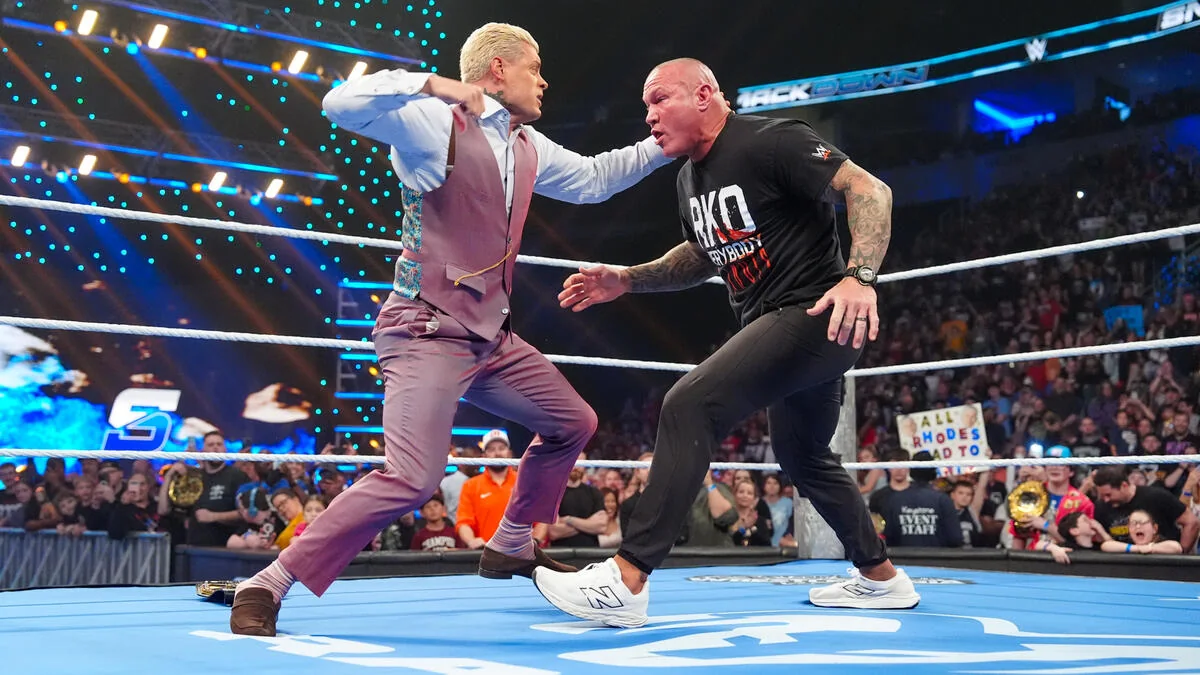
The current story asks how far Rhodes will go against his former mentor. WWE's Crown Jewel preview recalls Orton attacking him after their WrestleMania 42 title match, including the punt. The recent build then showed Rhodes using that same kind of offense against Baron Corbin. Those televised actions give the stipulation a specific character question alongside its standing-count objective.
On October 16 SmackDown, Orton interfered in Rhodes' match with Corbin to cause a disqualification. Rhodes subsequently punted Corbin in Orton's view. The official result and the post-match act should remain separate: the DQ settled the match result, while the punt advanced the rivalry's presentation. It is not evidence for an independently diagnosed injury.
In our reading, Rhodes proposing Last Man Standing on October 23 responds to the problem the feud has set for him. He is asking for a format that removes the familiar DQ exit and requires a prolonged inability to recover. That suggests a desire to prove something through the manner of victory, rather than merely obtain another standard singles result.
There is a danger for the character in that choice. Wanting to defeat Orton and wanting to imitate Orton's most ruthless behavior need not lead to the same decision. The stipulation permits escalation, but permission does not require a wrestler to choose every available tactic. Watching where Rhodes exercises restraint, or abandons it, may therefore matter as much as counting the major moves.
The September meeting provides background without needing to dominate this preview. Our analysis of their September finish covers the hesitation and subsequent debate. Crown Jewel adds a new rule environment to that unresolved tension. The important question now is how each man adapts to it.
A more aggressive performance would not automatically confirm a permanent heel turn, and a victory would not reveal a real-world personality change. Those are interpretations of a continuing wrestling character. The useful evidence will be what Rhodes and Orton actually do, how the referee records the result and whether the following shows treat it as closure or another grievance.
What to follow before and during Crown Jewel
Crown Jewel is advertised for November 7 at noon Eastern and 9 a.m. Pacific. WWE's current U.S. viewing instruction is the ESPN App with an ESPN Unlimited plan, with Netflix promoted internationally. Check your region's listing before the show. That advertised start belongs to the event as a whole; no individual bell time for Rhodes versus Orton follows from it.
Use the PLE schedule for the event and the current match cards for later additions or changes. Attending fans should also check the latest venue and ticket instructions following the October 28 move announcement. Our Crown Jewel venue-change guide handles that separate planning question.
During the match, focus on how the rule affects the choices. Does a wrestler allow the referee to count after a major move? What allows the opponent to recover? Does the setting change the options? These are more revealing questions than trying to guess a predetermined number of RKOs or Cross Rhodes before the finish.
Judge the recorded finish before declaring the rivalry settled
Afterward, establish the official winner and the complete final count sequence. Then consider how the result answers the feud's character questions. A direct victory, an assisted victory and an inconclusive ending would leave different material for the following SmackDown. The stipulation makes a particular kind of finish possible; it does not announce the entire aftermath in advance.
This remains a preview checked on October 29. Neither wrestler has won the November 7 match at that cutoff. For the result after the event, follow WWE results and the next official show account. Watch the referee's count first, then the wrestlers' reaction to it: that is where the match's rules and the rivalry's next direction meet.
Join the discussion
Comments