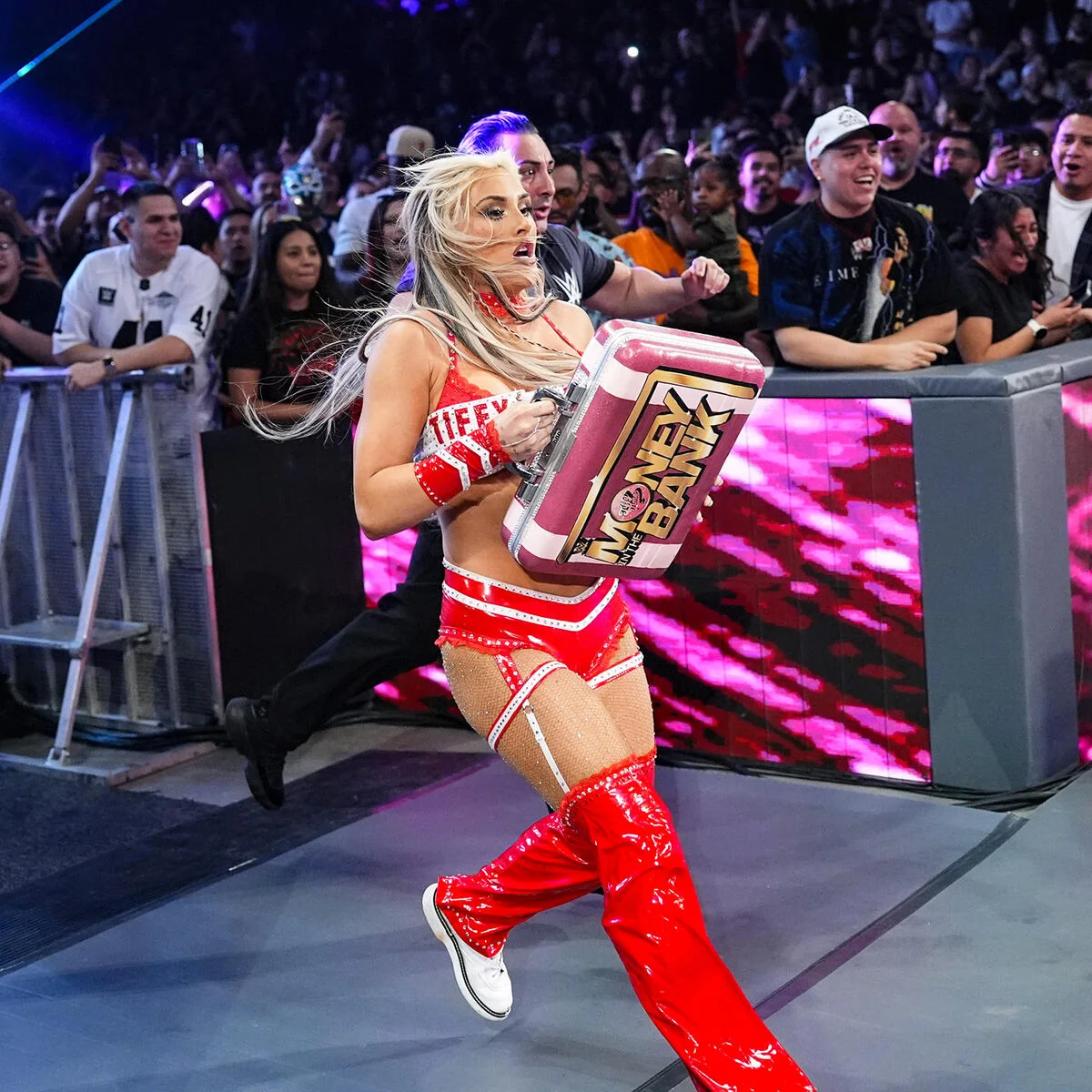
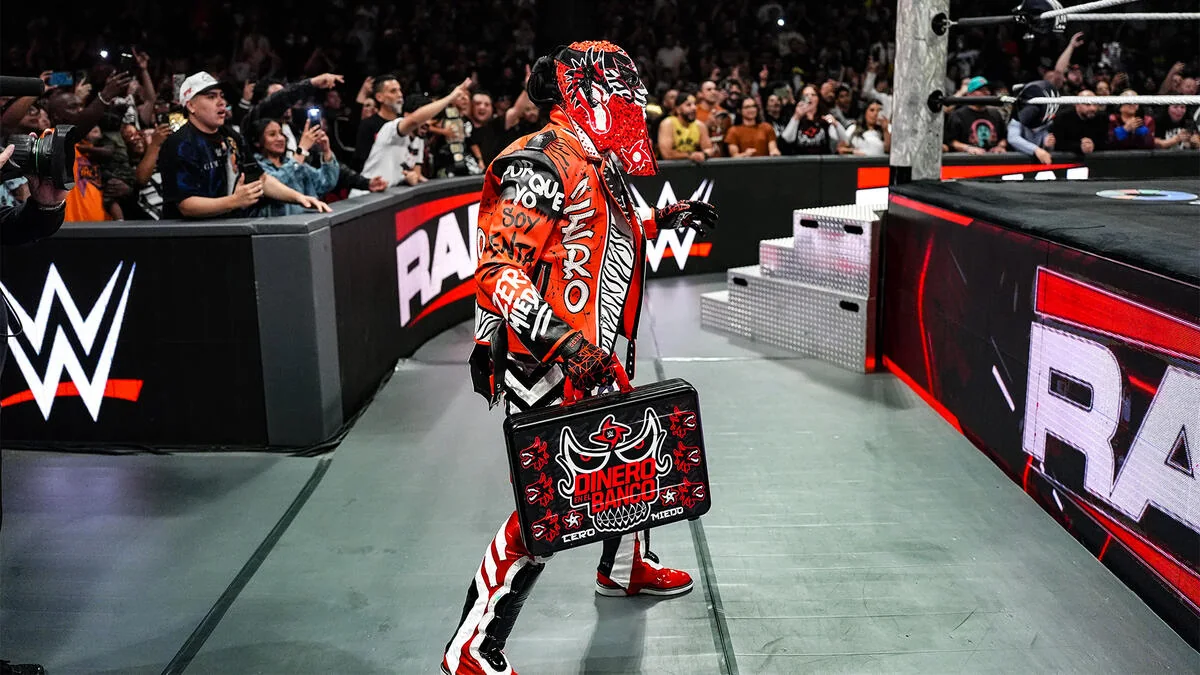
Tiffany Stratton and Penta did not lose their Money in the Bank contracts on Raw on October 26, 2026. Both tried to exploit a championship opening, and both were stopped before completing a cash-in. The distinction matters: an interrupted approach leaves a different result from a championship match that starts and ends without a new champion.
Results spoilers follow for that Raw and the historical matches discussed below. This guide explains the referee, bell and championship-outcome distinctions using the current holders, then contrasts their near-misses with actual completed cash-ins. Status is dated October 29, before the next SmackDown.
The briefcase buys a championship opportunity, not a championship
Money in the Bank gives its holder a championship match opportunity; the holder still has to win the championship. WWE's 2026 qualifying announcement describes a world-title match at a time and place of the winner's choosing within the next year. The freedom to choose an opening is the advantage. It is not a guarantee that the opponent will lose, that interference cannot occur, or that every appearance with the briefcase begins a sanctioned contest.
Three separate achievements often get compressed into the phrase "Money in the Bank winner." First comes winning the ladder match and securing the contract. Next comes using that opportunity to enter a championship match. Finally comes the result of that match. A wrestler can succeed at the first step and fail at the last, or threaten the second step several times before completing it. That distinction explains much of the confusion around Raw on October 26.
Tiffany Stratton and Penta won the 2026 contracts
The relevant holders are Tiffany Stratton and Penta. WWE's October 10 results confirm Stratton won the women's ladder match and Penta won the men's in New Orleans. WWE identifies Stratton's win as her second Money in the Bank contract. Those are completed results, unlike predictions made while the qualifying field was still taking shape.
For these two characters, carrying the contract creates leverage over a champion's entire evening. A demanding defense, an attack or a distraction may provide an opening. The champion's allies consequently have a second job after helping with an ordinary opponent: keep the holder from exploiting what comes next. That pressure is why a failed approach can matter to a storyline without changing either the championship record or ownership of the unused opportunity. The next useful question is what the broadcast actually established, rather than how loudly the entrance music suggested a title change.
What happened to both cash-in attempts on October 26?
The two October 26 interruptions reached the same broad outcome through different routes. Penta was stopped while another championship match was underway. Stratton threatened a fresh match after the women's main event had ended. WWE's Raw report presents both as opportunities that did not become completed cash-ins. Neither sequence should be added to a list of holders who lost their resulting championship match.
Bron Breakker stopped Penta before he could enter the title match
Sami Zayn was defending the Undisputed WWE Championship against Je'Von Evans when Penta appeared. Bron Breakker attacked Penta from behind at ringside before he could cash in. Evans then left the ring to attack Breakker, and the distraction opened the way for Zayn to hit the Helluva Kick and win. The subsequent assault by Breakker and Bronson Reed made the interruption more costly physically, but it did not turn Penta into a defeated third entrant.
The existing match had its own finish. Zayn defeated Evans; he did not pin Penta to eliminate the contract. Nor did Breakker win Money in the Bank by attacking its holder. A third party can stop a plan without acquiring the opportunity that plan depended on. For a results reader, that means keeping the Zayn-Evans title defense on one line and Penta's interrupted approach in the accompanying explanation. Combining them into a Triple Threat result invents a match WWE did not record.
Dominik Mysterio pulled Liv Morgan away from Tiffany Stratton
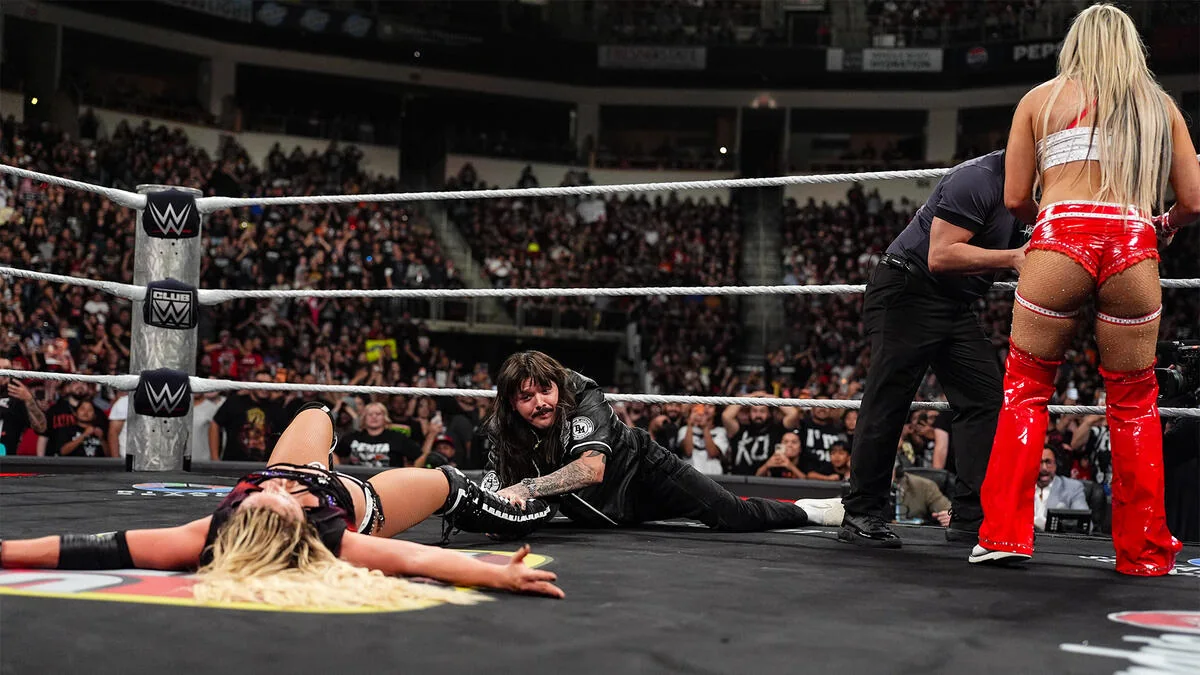
The women's sequence began after Becky Lynch's disqualification win over Women's World Champion Liv Morgan. Chelsea Green and IYO SKY became involved against The Judgment Day, and Stratton hit Morgan with the Prettiest Moonsault Ever. As POST Wrestling's account describes, Stratton tried to convert that opening into a cash-in, only for Dominik Mysterio to pull Morgan out and carry her away.
The important absence is a completed Stratton-Morgan championship match. Morgan escaping the immediate danger did not count as a pinfall over Stratton, and Stratton striking the champion did not itself make her champion. It was a frustrated opportunity with the contract's threat still hanging over the division. WWE's official highlight calls it an attempt. That description is more precise than the casual shorthand "Tiffany failed her cash-in," which can wrongly suggest the opportunity has been spent.
When does a cash-in become a championship match?
The useful dividing line is whether WWE has actually started or officially expanded a championship match through the contract. The holder's intention matters to the story, but intention alone is not a result. Running down the aisle, bringing a referee, opening the briefcase or attacking a vulnerable champion can all precede a match. They should not automatically be treated as the completed use of the opportunity.
This is best understood through the sequence WWE presents rather than an imaginary contract clause. Watch the holder communicate the decision, the official recognize it and the contest get underway. In a fresh singles cash-in, the bell is the clearest audible marker. In an existing match, pay attention to the announcement that the holder has joined it and the resulting match structure. A cropped social clip that stops before those details can produce a misleading impression of what happened.
The referee and the bell matter more than the entrance music
Baron Corbin's 2017 attempt supplies a particularly clear official example. WWE describes him handing over the contract, the bell ringing and Jinder Mahal subsequently pinning him. That provides an actual beginning and ending. The account says Mahal struggled upright before the bell, but describing that one scene is not the same as establishing a universal rule that every champion must stand before every cash-in.
There is also clear precedent for a holder remaining dangerous after repeated interruptions. WWE's January 2024 Priest-McIntyre preview describes Drew McIntyre thwarting Damian Priest's attempts. Those incidents created a rivalry around preventing the opportunity; they were not several completed losses that somehow generated replacement contracts. For Tiffany and Penta, the same viewing distinction is essential. Ask whether a championship match actually began before deciding that a frustrating interruption used up the briefcase. An ally getting the champion out of danger before that point can save the champion tonight while leaving tomorrow's threat intact.
A completed cash-in can fail even when the holder wins
Once the contract has produced an actual championship match, the holder must deal with the match's result. The opportunity is a chance to compete for the belt, not an insurance policy against an unfavorable finish. Two historical examples answer different parts of the question: Corbin lost his match, while Cena won his match but failed to take the championship. Calling both unsuccessful cash-ins is accurate only if the measure of success is capturing the title.
Baron Corbin lost after the match had started
On August 15, 2017, Corbin interrupted John Cena's encounter with WWE Champion Jinder Mahal. After recognizing the damage Mahal had taken, Corbin returned to cash in. The official accepted the contract and the bell rang. Corbin then turned his attention to Cena on the apron, giving Mahal the opening to roll him up. WWE recorded a Mahal victory in the newly started championship match.
That sequence supplies the ending missing from Penta's October 26 approach. Penta was attacked before entering the title contest; Corbin entered one and was pinned. Both men were distracted or obstructed by someone outside their intended championship confrontation, but the timing changed the consequence. Corbin's story is therefore a useful warning against counting every interruption in the same category. A champion surviving the danger before a match starts and defeating the holder after it starts are materially different results.
John Cena won by disqualification without winning the title
Cena's case is stranger if you think success means simply winning. He announced in advance that he would use his contract against CM Punk on Raw's 1,000th episode, July 23, 2012. During the match, Big Show attacked Cena. The official Raw 1000 report records a disqualification victory for Cena, while Punk kept the WWE Championship. The match had happened; the championship had not changed hands.
This is the essential qualification behind the familiar phrase that the contract guarantees a title match. In an ordinary championship contest, a DQ victory does not transfer the belt unless a specific stipulation says otherwise. Cena secured the win awarded by the referee but not the title he wanted. The contract did not become a renewable entitlement simply because interference made the finish unsatisfying. WWE's contract history accordingly lists the DQ win alongside no championship captured.
The practical lesson applies before cheering any future bell. A holder needs an outcome that actually wins the championship under that match's conditions. A rival's attack, a protective ally or a disqualification can frustrate that goal after the opportunity is already in use. That is why getting the match started is a major threshold, but it is only one threshold on the way to a title change.
Cashing in during a match changes the problem for everyone
A holder does not always wait for a champion to finish wrestling. Seth Rollins' cash-in at WrestleMania 31 on March 29, 2015, is the clearest example of the alternative. Brock Lesnar and Roman Reigns were already competing for the WWE World Heavyweight Championship when Rollins entered through his contract. The contest became a Triple Threat, and Rollins pinned Reigns to win the championship. WWE's match report identifies all three participants and the title change.
The tactical significance is considerable: Lesnar lost his championship without being the wrestler pinned. Adding an opponent can give the holder another route to a decisive fall, while forcing the original challenger to react to someone who was absent for much of the damage. The champion's problem expands from beating a single challenger to preventing either opponent from finishing the other. It is one reason Penta appearing during Zayn versus Evans carried a real threat even though Breakker stopped the plan.
The same route offers no promise of success. At Money in the Bank on July 6, 2024, Drew McIntyre joined Damian Priest's World Heavyweight Championship defense against Rollins. WWE records the conversion to a Triple Threat, CM Punk attacking McIntyre and Priest pinning McIntyre after South of Heaven. The fresh entrant became the wrestler who lost the deciding fall. He had obtained the match through his contract, but an existing enemy still changed its outcome.
These examples show why an actual mid-match cash-in must be identified from the presented contest. They do not authorize every theoretical combination fans can imagine. In particular, a champion-versus-champion advertisement does not by itself announce a contract match for two regular world titles. For any unusual future attempt, wait for WWE to establish which championship is at stake and how the bout is being contested. A past Triple Threat is a precedent for entering an ongoing title match, not proof of every proposed trophy, unification or double-title scenario.
How to follow the next attempt without falling for a false result
The arguments after Raw are not all about misunderstanding the rules. In the October 27 SquaredCircle comparison thread, some viewers objected to the familiar delay between a holder arriving and the champion escaping. Others felt the 2026 referee exchange was reasonably quick. That is a disagreement about execution and repetition, not evidence that either contract has disappeared. It is possible to understand why a match never started and still dislike the way the show prevented it.
The strongest criticism asks what the next attempt changes. Does the holder anticipate the ally who stopped the last one? Does an opposing faction have to divide its attention? Does a previously interrupted approach create a concrete feud rather than another identical near-miss? Those are storytelling questions. They can be answered by subsequent segments without inventing a regulation that forces a cash-in to succeed after a particular number of interruptions.
For the next show, follow three details in sequence: whether the opportunity is officially activated, who actually participates in the resulting match, and whether the finish transfers the championship. Keep the contract holder separate from the reigning champion until the final detail is settled. If a clip shows only the run-in, seek the full ending before calling it a failed cash-in or a new reign. If the match is interrupted, the official result explains whether the holder was a participant or was stopped beforehand.
As of this October 29 guide, the October 26 scenes leave Tiffany Stratton and Penta with unresolved contract opportunities. The Raw schedule, SmackDown schedule and dated results are the useful next stops. A future successful cash-in would change that status immediately; a prediction about Crown Jewel or WrestleMania does not change it today.
Join the discussion
Comments