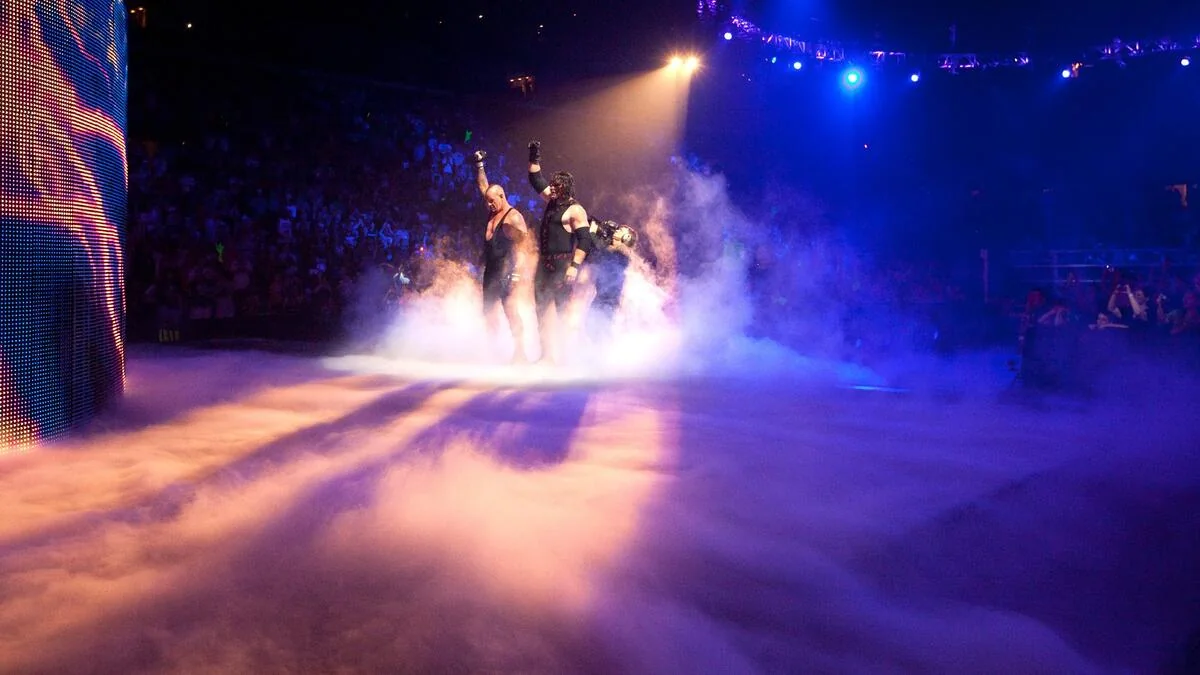
Undertaker and Kane are half-brothers in WWE's fictional storyline. Mark Calaway and Glenn Jacobs, the performers behind them, are not biological brothers. The Brothers of Destruction name comes from their on-screen relationship and tag-team partnership. Here is how the 1997 reveal, the first rivalry and the later team fit together.
Updated October 19, 2026. Historical match results and storyline events follow.
Undertaker and Kane are brothers in WWE's story
Undertaker and Kane are not biological brothers in real life. WWE presented their characters as half-brothers and later paired them as the Brothers of Destruction. The family connection belongs to the fictional story that gave their rivalry and partnership an unusually long history.
That distinction helps when an old recap calls Kane Undertaker's younger brother without adding an explanation. WWE often writes historical match stories from inside its fictional world. The wording tells you the relationship the audience was asked to follow, rather than establishing a real family connection between the performers.
Fans often call that in-universe presentation kayfabe. A match recap can say that one brother betrayed the other while a documentary discusses two colleagues planning and performing the same scene. Both describe the production at different levels. Confusion starts when a character's childhood story is repeated as a fact about the person portraying him.
Mark Calaway and Glenn Jacobs are the performers
Mark Calaway portrays The Undertaker; Glenn Jacobs portrays Kane. In a November 15, 2020 TV Insider interview, Jacobs discussed their work together and the distinction between the characters and the people. WWE's Brothers of Destruction documentary likewise brought the performers together to reflect on that history.
| Question | Answer |
|---|---|
| Who plays Undertaker? | Mark Calaway |
| Who plays Kane? | Glenn Jacobs |
| Are the performers biological brothers? | No |
| Are the characters brothers? | Yes, half-brothers in WWE's storyline |
You do not need a catalog of their private relatives to understand the answer. The important identities are the two performers and the two roles. Their professional relationship explains how the story was made; the fictional relationship explains why the characters could be enemies one year and protective partners in another.
Read the dates that follow as chapters of that WWE narrative. References to family secrets, fire, betrayal or reconciliation concern the characters unless a passage explicitly discusses the performers reflecting on their work.
Paul Bearer's story gave Kane a reason to confront Undertaker
Paul Bearer was the bridge between the established Undertaker character and the new Kane character. As an unsettling manager with a long association with Undertaker, he could introduce a supposed family secret that felt relevant to an audience already familiar with The Deadman. The threat began as something personal before Kane physically entered the ring.
WWE's Paul Bearer profile describes the later revelation that his character was Kane's father, with Undertaker's mother. Within the fiction, that explains the half-brother relationship. It does not identify the real parents of Calaway or Jacobs.
The childhood fire belongs to the fictional backstory
WWE's rivalry-origins feature recounts the story of a fire at the funeral home where the characters grew up. Kane had supposedly survived, and Undertaker was accused of causing it. The accusation supplied a revenge motive and a reason for a hidden brother to emerge.
Read that as horror fiction embedded in wrestling. The funeral home, the alleged childhood events and the family accusations explain the characters' actions. They are not evidence that the performers experienced those events. When different eras retell or develop the mythology, keep the question focused on what the audience was being told in that chapter.
Kane arrived at Badd Blood on October 5, 1997
The reveal became a physical confrontation at Badd Blood: In Your House on October 5, 1997. Kane appeared during Undertaker's match with Shawn Michaels inside the first Hell in a Cell, tore open the Cell entrance and attacked Undertaker. The arrival affected the match immediately, costing Undertaker the victory.
That setting made the introduction more than a backstage explanation. A major new character interrupted an already important match and stood opposite the established figure he was supposed to resemble and resent. For a viewer beginning the story, this is the essential first scene: the hidden threat became visible, and the family narrative entered the competitive action.
The date identifies the Kane character's debut. It should not be stretched into a claim that Jacobs had never wrestled or appeared under another identity beforehand. The story depends on the unveiling of Kane, which is the identity this guide follows.
Their first rivalry led to WrestleMania XIV in 1998
The first major singles destination was WrestleMania XIV on March 29, 1998. WWE's official results record Undertaker defeating Kane, who had Paul Bearer with him. The match followed months of story development after the October unveiling.
WWE's account of the rivalry emphasizes the difficulty of that victory: Undertaker needed three Tombstone Piledrivers to defeat Kane. As a story detail, that mattered because Kane was presented as a threat who could withstand the established character's defining offense. The win resolved the match without making the new character's entire purpose disappear.
For a new viewer, watch the confrontation as a culmination rather than an isolated contest. Undertaker's hesitation about fighting his supposed brother and Kane's revenge motive provided reasons for the showdown beyond a ranking or a championship. Knowing those motivations makes the pacing and the repeated attempts to finish the match easier to understand.
The Casket and Inferno matches extended the conflict
The Royal Rumble on January 18, 1998 supplied an important step before WrestleMania. Kane and Bearer attacked Undertaker around his Casket Match with Shawn Michaels, and the casket was set ablaze as part of the angle. This was a staged WWE scene, not evidence of an actual death or a real family incident.
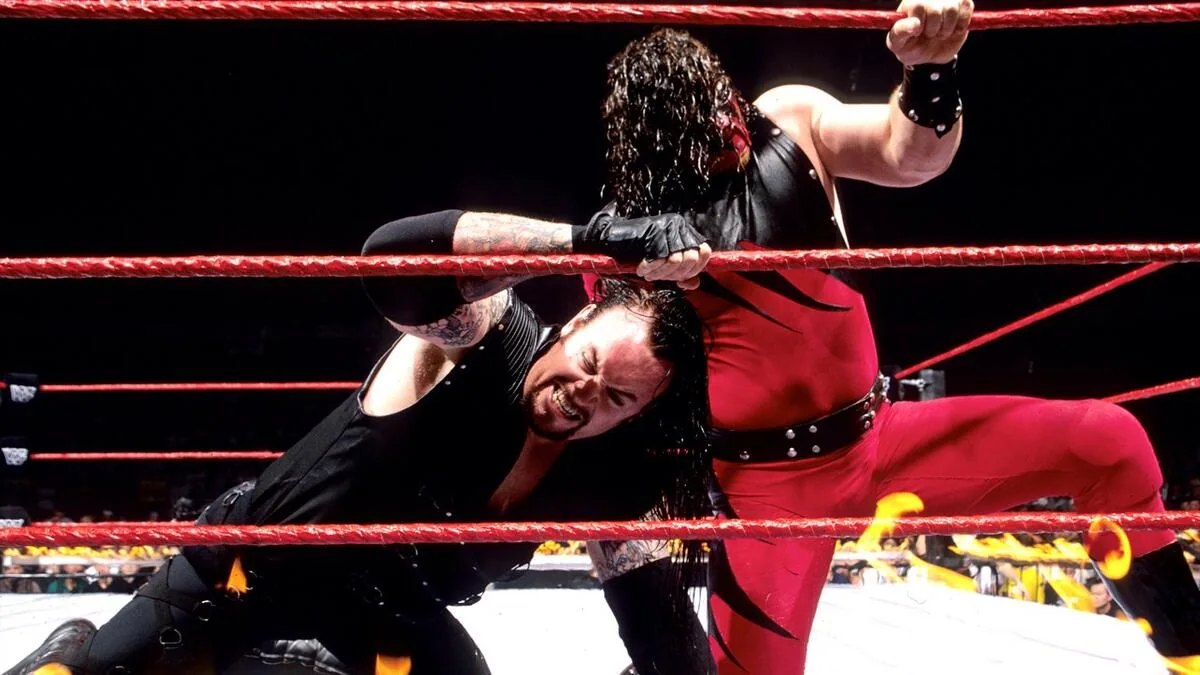
After WrestleMania, the first Inferno Match followed at Unforgiven on April 26, 1998. WWE's Inferno Match history records Undertaker winning after Kane's arm caught fire in the performed finish. The special stipulation carried the fire imagery from the backstory into the presentation of a match.
Those chapters explain why a simple list of wins misses part of the appeal. The Casket incident escalated the hostility; WrestleMania supplied the long-awaited direct fight; Inferno offered a new spectacle rather than repeating the same scene. Each used the established mythology to give the next encounter a different emphasis.
Keep the match titles attached to their event dates. “Kane versus Undertaker” covers many years, so an undated clip of an entrance or a fire sequence can easily be placed in the wrong part of the story.
The Brothers of Destruction became a championship team
The Brothers of Destruction were more than two famous characters sharing an entrance. Undertaker and Kane competed together for tag-team championships, making their partnership a distinct part of both careers. The name identifies those periods of cooperation, even though their history also contains long stretches as opponents.
Keep their joint record separate from each man's other partnerships. WWE's history of Kane's tag partners includes other combinations. A championship won with another teammate does not become a Brothers of Destruction title simply because Kane later reunited with Undertaker.
Their 2001 title wins made the partnership concrete
WWE's SmackDown milestones date their victory over Edge and Christian to April 19, 2001. That win brought them the World Tag Team Championship. It gives a new viewer a specific match to find when moving from the rivalry to the team.
On the August 9, 2001 edition of SmackDown, they won the WCW Tag Team Championship. At SummerSlam that month, their Steel Cage victory over Diamond Dallas Page and Kanyon brought the two organizations' tag titles together. WWE's unification history explains the unusual championship situation and the later separation of the belts.
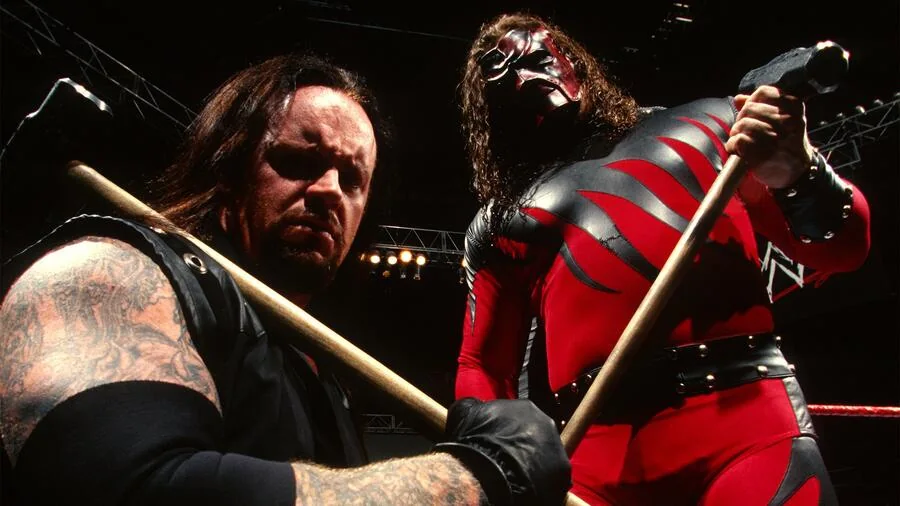
For this era, use the belt's lineage as well as its name. An old event may be described with modern WWE terminology in a retrospective, while the original footage uses the company's earlier branding. That naming difference should not lead you to count one historical title win as two separate matches.
Reunion and rivalry remained part of the same story
Their connection remained flexible. WrestleMania XX in 2004 brought another singles confrontation, while November 3, 2006 on SmackDown supplied a reunion. Raw 1000 in 2012 offered another recognizable return of the duo. Those are selected chapters rather than evidence of one uninterrupted team run.
At Survivor Series 2015, the pair defeated Bray Wyatt and Luke Harper. The alliance could be revived against a common threat because the audience already knew the relationship. Read a reunion as a change in the characters' immediate allegiance, not as a change in the performers' real ancestry.
The characters and the real partnership explain the appeal
The fictional relationship gave WWE two usable kinds of drama: a personal enemy who understood Undertaker's world and a partner who could stand beside him against another threat. In editorial terms, the shared mythology made both arrangements recognizable. A reunion could draw on the rivalry's history rather than introducing two unrelated characters from scratch.
The visual contrast was deliberately built. In a June 13, 2020 Sports Illustrated interview, Jacobs described Kane as an opposite to Undertaker and credited Calaway with the idea behind his ring-post fire gesture. He also discussed Bearer's role in preparing the audience for the character before the debut.
That is useful context when watching the entrance. The performance was designed to make a new threat feel connected to an established figure while giving the newcomer his own identity. A familiar movement, a changed presentation and a clear narrative relationship could communicate something before either character needed a long explanation in the ring.
The real working partnership adds another layer. In the TV Insider interview, Jacobs described a relationship that developed from learning from Calaway into a friendship between colleagues who could discuss how to improve their matches. That is his account of their professional bond, rather than an extension of the fictional family story.
WWE's 2020 Brothers of Destruction documentary offered a different viewing mode from a match recap: the performers could reflect on the characters they had portrayed. A viewer can appreciate the planning and cooperation without needing to treat the fictional fire or supposed family secret as real. Understanding the craft can explain why the original presentation was memorable.
This also helps avoid reading too much into a later appearance. A shared photograph or retrospective interview confirms that occasion; it does not automatically announce another match. Likewise, a character attacking his supposed brother is not evidence of a private dispute between Calaway and Jacobs. Keep the date, setting and type of source attached to each claim.
For his individual career, use WWE's Undertaker profile. For current Superstars, browse the WWE roster index. For their shared story, the most helpful next step is a short chronological viewing route.
Watch the main chapters in chronological order
For a first viewing, choose a few clear chapters rather than jumping between unrelated highlight packages. The route below follows the character reveal, the first direct rivalry, the championship partnership and a later reunion. It is a starting point, not a claim to contain every confrontation.
| Event or episode | What to watch for |
|---|---|
| Badd Blood, October 5, 1997 | Kane's reveal interrupts Undertaker versus Shawn Michaels. |
| WrestleMania XIV, March 29, 1998 | Their first singles showdown pays off the initial build. |
| Unforgiven, April 26, 1998 | The first Inferno Match continues the fire motif. |
| SmackDown, April 19, 2001 | The partnership wins tag-team gold against Edge and Christian. |
| WrestleMania XX, March 14, 2004 | Another rivalry chapter accompanies Undertaker's return. |
| Survivor Series 2015 | A later team chapter against Bray Wyatt and Luke Harper. |
Search the official archive by the event name and year. A show called WrestleMania has many editions, and the same performers can have very different roles in each. Use the official dated history to orient the sequence, then check the actual event listing or result.
Use the episode date to keep changing identities straight
The presentation evolves across the years. Undertaker's biker-era appearance and his supernatural Deadman presentation belong to different chapters of the same performer's work. Kane likewise appears with different masks and later without one. A visual change does not by itself establish a new actor, an actual injury or a different real family relationship.
WWE's WrestleMania XX page is a useful anchor for the 2004 return. Read that year's story before comparing it with a 2001 team entrance. If you watch only a short clip, check its original date before interpreting whether the characters are cooperating or fighting.
For access, check the current authorized service in your country and whether that specific archive item is included. A historical article's old WWE Network promotion is not a promise about today's subscription catalog. The WWE TV guide can help with current viewing context; the episode date helps you find the right story.
Start with Kane's Badd Blood reveal, then watch WrestleMania XIV and a 2001 team chapter. Keep the fictional brothers and the real performers distinct, and both the rivalry and the partnership become easier to follow.
Join the discussion
Comments