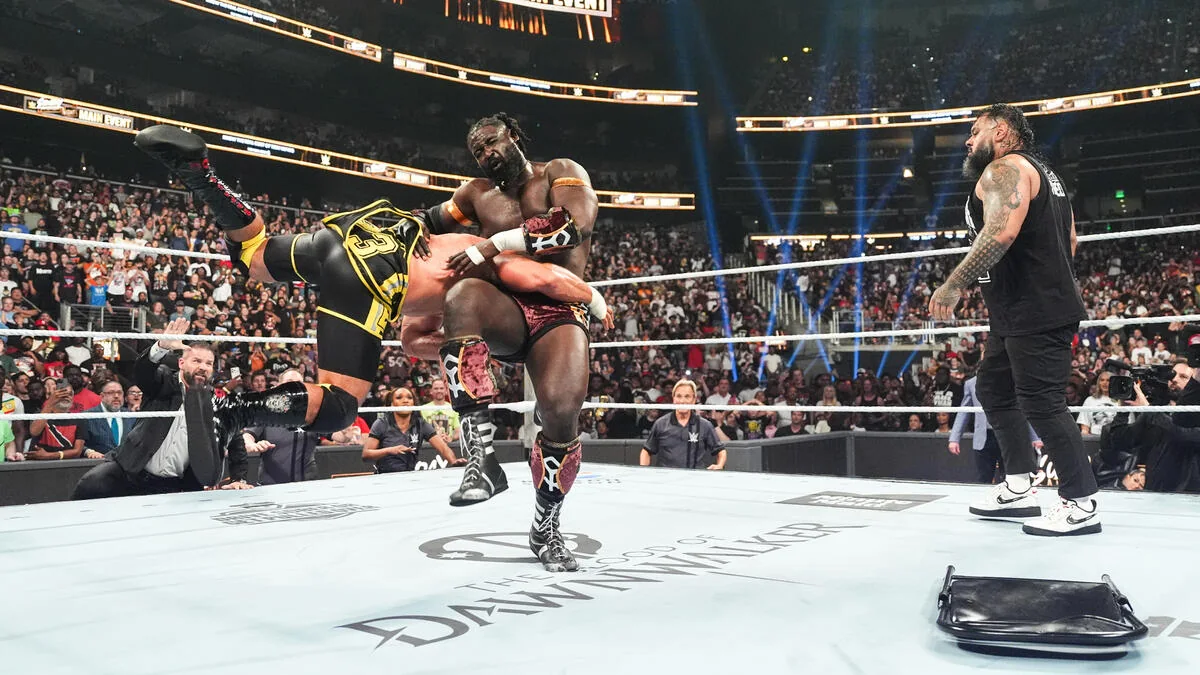
Spoilers for Sunday Night's Main Event on September 6 and Raw on September 7, 2026. Oba Femi officially beat Bron Breakker by disqualification when Bronson Reed returned and attacked him with a steel chair. The Vision's assault after the bell explains why Breakker's side looked dominant despite losing the match.
Updated September 8, this analysis follows the interference in order, looks at the singles contest before it broke down, and separates the confirmed Raw fallout from possible future directions. The central distinction is simple: Femi received the win, while the advertised question of who could decisively beat the other remains unresolved.
Oba Femi won by disqualification on September 6
Oba Femi defeated Bron Breakker by disqualification at Sunday Night's Main Event on September 6, 2026. Bronson Reed returned and attacked Femi with a steel chair, ending the match. The Vision then continued attacking the official winner. WWE's published SNME results give Femi the victory without ambiguity.
The closing picture explains why a quick clip can be misleading. Breakker and Reed were standing over Femi, but that happened after the referee's decision. They did not turn the assault into a pinfall victory. If you are recording results, the accurate entry is Femi by DQ; if you are describing the storyline, The Vision overwhelmed him after the bell. Both observations matter, and neither replaces the other.
This also was not a no-contest. WWE awarded a winner through disqualification rather than leaving the result undecided. What remained unanswered was the competitive question that brought the two wrestlers together: which man could beat the other in a completed singles contest without outside intervention? The record supplies a winner while the match leaves that narrower question open.
No championship changed hands in this bout. Breakker's association with the World Tag Team Championship did not make this a tag-title defence, and Femi's win did not award him a new belt. The stakes were personal standing, momentum and the rivalry promoted around WWE's future.
The event took place in Atlanta, with contemporary reporting on Reed's return likewise distinguishing the DQ from the subsequent attack. For viewers catching up after Monday's Raw, keep September 6 attached to this result: the following night's Otis match produced another DQ involving Reed, but it was a separate match with a different official winner.
What the singles match established before the interference
WWE promoted this as the two men's first one-on-one meeting, built around their competing claims to represent the company's future. Its original match preview connects the confrontation to Femi's SummerSlam Hell in a Cell victory over Brock Lesnar and the August 17 Raw segment in which Paul Heyman and Adam Pearce arranged the match.
That framing gave Breakker something more specific to challenge than an unbeaten-looking opponent. Femi had acquired a powerful piece of credibility, and Breakker wanted to question the attention surrounding him. His offence therefore needed to look capable of disrupting Femi's momentum. Otherwise, the eventual arrival of teammates would be the only thing the challenger to Femi's status contributed.
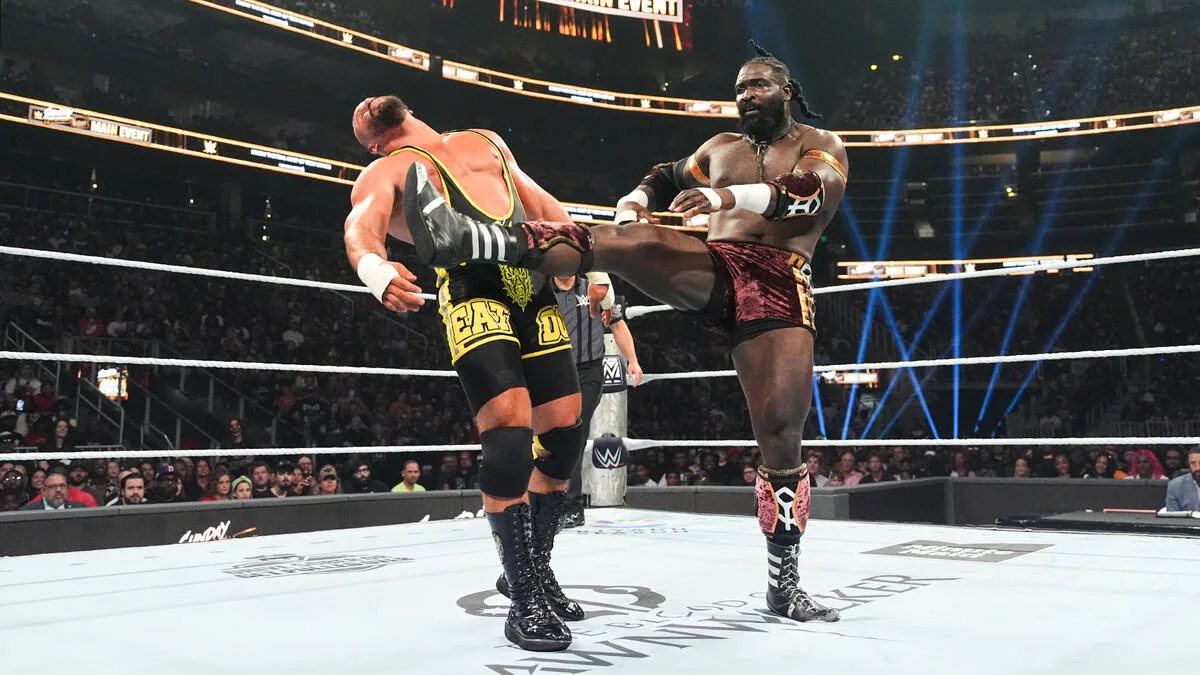
The opening strength tests gave the contest a clear visual premise: neither man could expect ordinary contact to settle it. Breakker then changed the setting, attacking from the apron and sending Femi over the announce desk. Moving outside the ring made room for acceleration and a bigger collision, instead of repeating the same stationary exchange until somebody fell.
Power, speed and the importance of the near-falls
Breakker's work was not limited to charging. The contemporary match recap records him using holds and suplexes to keep Femi under pressure. That change of pace mattered: slowing the opponent created a contrast with the next burst of speed and gave Femi a problem to escape before launching his comeback.
Femi's recovery, in turn, made his strength feel like an answer to pressure rather than a substitute for having to endure it. He could be driven backwards, held down and struck hard, yet still produce a sudden reversal of momentum. Breakker kicking out after the chokeslam stopped that recovery from becoming an immediate victory. It gave both men a meaningful survival moment before the match became dominated by outside arrivals.
Later, Femi survived Breakker's Spears, as documented in WrestleZone's review. A near-fall is useful evidence of resilience; it is not proof that the wrestler kicking out was guaranteed to win the next exchange. The distinction matters here because the interruption arrived before either man produced the decisive fall.
My reading is that the singles portion succeeded in making another meeting attractive. Breakker had enough sustained offence to demand an answer, while Femi's comebacks supplied that answer without ending the contest too easily. The question left by the finish concerns the missing resolution. It should not erase the contrast in pace, recovery and power that the wrestlers had already established.
How The Vision turned the finish into Bronson Reed's return
The ending escalated through several different attempts to help Breakker. Treating the whole sequence as one generic distraction misses the point: Femi repeatedly overcame the assistance already in front of him before Reed supplied the interruption that finally stopped the match.
Theory, Paul and Dupri failed to secure a pinfall
Austin Theory arrived first and was thrown through the announce table. Femi dealt with that immediate threat, but the interruption created an opening for Breakker to attack. Even after the Spears, however, the cover did not produce a three-count. Outside help had changed the momentum without securing the result The Vision wanted.
Logan Paul then approached with brass knuckles and drew the referee's attention. Maxxine Dupri supplied another pair to Breakker from the other side. The PWMania account of the finish describes Femi avoiding the loaded punch and throwing Breakker before setting up his next attack.
That is an important distinction for anyone watching only part of the sequence: the brass-knuckle attempt did not become a successful finishing punch. Femi countered it. Paul's presence functioned as a diversion, but Dupri's delivery still did not produce the intended outcome.
The referee responding to Paul also explains the scene more precisely than saying the official ignored everything. Attention was directed toward one visible problem while another developed elsewhere. Whether that repeated distraction device is satisfying television is a fair question; it is separate from identifying which action actually caused this particular DQ.
Reed's chair shot ended the match before the attack continued
Reed struck Femi with a steel chair, and the bell followed. The Slam Wrestling report places that attack before the subsequent Tsunamis and Spears. Once the disqualification had ended the bout, further punishment could intensify the story but could not produce a new pinfall in the match that had already finished.
WWE's official Reed return highlight is the useful clip for that change in emphasis. The scene moved from Breakker trying to defeat Femi to a returning faction member helping overwhelm him. Reed entered a rivalry already under way and immediately became central to its next question.
From a storytelling perspective, the number of failed attempts before Reed arrived made Femi difficult to stop. The attack also gave Reed a clear role on his return: he was the additional force that finally left Femi unable to answer the group. This is an interpretation of the televised sequence, not evidence of a private creative plan or a medical conclusion about the performers.
It also leaves Breakker in an awkward but potentially interesting position. His group achieved the closing show of strength, yet he did not demonstrate that he could finish Femi himself. That tension fits the rivalry's original argument about individual standing. It will matter more if later episodes address it than if the only lasting consequence is another large attack.
Raw on September 7 made the conflict bigger
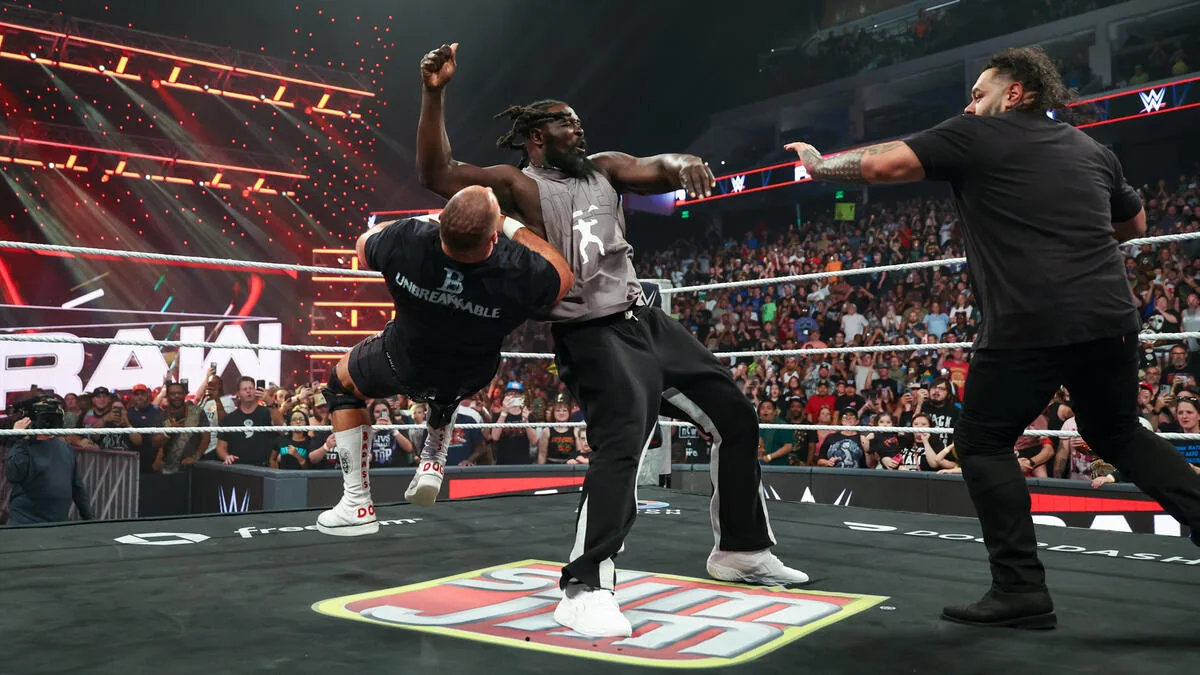
The immediate follow-up arrived on Raw the next night. The Vision celebrated what they had done to Femi, with Reed alongside Breakker, Logan Paul, Austin Theory and Maxxine Dupri. WWE's September 7 results then record the group attacking Femi, Otis and Akira Tozawa.
Otis and Tozawa brought an existing grievance into the scene. WWE's July account of Alpha Academy's conflict with The Vision describes Dupri leaving them and joining the opposing faction. Their presence therefore connected Femi's new problem with an established one. They were not simply two unfamiliar wrestlers added to make the sides look more even.
The practical change is that Femi now has more than one opponent to consider and other wrestlers have reasons to oppose the same group. That gives the programme possible directions beyond repeating the original singles match immediately. Sharing an enemy, however, does not by itself announce a new stable, a permanent partnership or a booked six-man tag.
Otis returned, while Breakker earned a separate opportunity
Otis defeated Austin Theory by disqualification after Reed interrupted his return match with an attack. The group assault followed. This was another example of the official result and the final physical advantage pointing in different directions, and another instance in which Reed helped stop an opponent from finishing a conventional match.
Femi's participation in Monday's confrontation is also a reason to avoid assuming that Sunday's dramatic ending meant a confirmed period away. The broadcast showed him involved again the next day. That establishes an on-screen appearance; it does not establish a medical diagnosis, clearance detail or recovery timetable, none of which is needed to explain the storyline.
Breakker then defeated Rey Mysterio and Ethan Page in a Money in the Bank qualifier. He landed a double Frankensteiner before finishing Mysterio with a Spear. That gave him a distinct competitive accomplishment on Monday: entry into the ladder match. It did not revise Sunday's loss by DQ, and it did not award the briefcase itself.
For the rivalry, that creates two tracks to follow. Femi has unfinished business with the group that attacked him, while Breakker has earned a route toward a future championship opportunity through Money in the Bank. The story could bring those tracks together, but interference in the ladder match or a specific revenge bout has not been established by these results.
Use the Raw schedule to follow the next episode, and judge any new announcement by its actual participants and stakes. Monday widened the conflict; it did not supply the decisive Femi-Breakker singles answer that Sunday withheld.
Was the disqualification a satisfying ending?
My assessment is that the match provided convincing competition and an effective return, but an incomplete payoff to the singles rivalry. Reed's arrival gave the programme an immediate development. It also denied viewers the decisive finish implied by a showdown promoted around who represents WWE's future.
The case for the return and the case for a decisive finish
The strongest argument in favour is that both wrestlers left with something intact. Femi survived Breakker's offence and several attempts at interference; Breakker was not pinned or submitted; Reed returned with a clear opponent and a forceful introduction.
The strongest objection is about what the audience was asked to invest in that evening. If the attraction was Femi versus Breakker, then ending their match to introduce someone else's attack changes the reward. A return can be memorable without satisfying the original question. Wrestling Inc.'s SNME opinion review took a more critical view of the pace and the predictable interruption.
The match discussion on SquaredCircle contains both responses: disappointment after enjoying the action, and approval of Reed's return and the possibilities it creates. Those comments illustrate a disagreement, rather than measuring the whole audience. It is reasonable to welcome Reed back while still wanting this specific contest to have reached a conclusive fall.
What would move the rivalry forward from here
The next useful development would change what Femi can do about the numbers against him. That might mean a direct confrontation with Reed, a clearly announced match condition, or cooperation with wrestlers who already oppose The Vision. These are possible storytelling directions, not announced matches. The September 7 coverage confirms the wider conflict but does not establish a date or stipulation for a Femi-Breakker rematch.
A stronger continuation would also give Breakker a chance to answer the original individual challenge. Another group attack can reinforce the faction's advantage, but it cannot demonstrate that he can beat Femi unaided. Likewise, Femi gaining revenge on one member would be meaningful progress without automatically resolving his issue with every other member.
For now, watch the singles exchanges and the return sequence as parts of the same episode, then follow Raw's actual announcements. The SNME schedule guide can help with future specials, but a date on the calendar alone does not confirm this rematch. September 6 belongs in the record as Femi's DQ win; the next chapter needs to show what he and Breakker do with the unfinished rivalry.
Join the discussion
Comments